
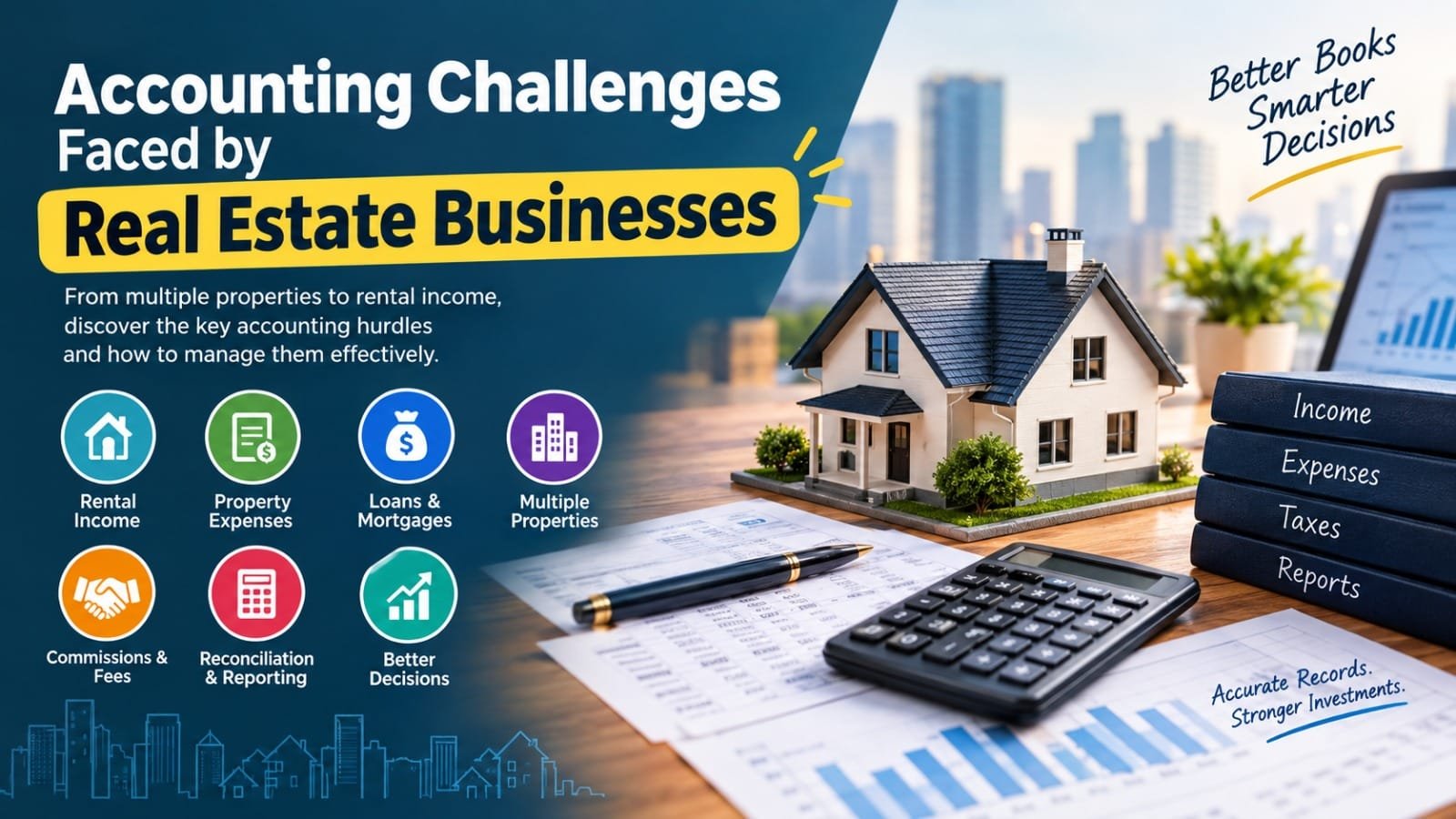
Accounting Challenges Faced by Real Estate Businesses
Real Estate businesses deal with transactions that are often much larger and more complex than those of many other businesses.
A real estate company may manage property purchases, sales, rentals, security deposits, mortgages, property improvements, commissions, maintenance expenses, tenant payments, and multiple properties at the same time.
How can a real estate business keep its books accurate when so many different financial activities are happening at the same time?
The challenge is not simply recording transactions. The business also needs to identify, categorize, track, reconcile, and report those transactions correctly.
For example, the accounting treatment of rental income is different from the accounting treatment of a property purchase. A repair expense is different from a property improvement. A tenant security deposit is different from rental income.
Therefore, real estate accounting requires a structured bookkeeping and accounting process.
1. Why Real Estate Accounting Can Be Complex
In a normal business, accounting may focus mainly on sales, purchases, payroll, operating expenses, and cash flow.
Real estate businesses can have many additional transactions.
Each stage can create different accounting transactions.
The business may also own or manage several properties, and each property may have different:
- Rental income
- Tenants
- Loans
- Maintenance costs
- Property taxes
- Insurance
- Utilities
- Repairs
- Management fees
2. Tracking Multiple Properties
One of the first challenges is knowing which property a transaction belongs to.
Suppose a real estate company owns five rental properties. During the month, it pays:
- $2,000 for repairs at Property A
- $1,500 for maintenance at Property B
- $3,000 for insurance for Property C
- $5,000 in property taxes for Property D
If these transactions are simply recorded as general expenses without proper property-level tracking, management may not know how much each property is actually costing.
This allows management to understand the financial performance of individual properties.
3. Recording Rental Income Correctly
Rental income is one of the most important sources of revenue for many real estate businesses.
But rental transactions may not always be as simple as:
There may be:
- Monthly rent
- Late fees
- Other tenant charges
- Discounts or concessions
- Partial payments
- Unpaid rent
- Advance payments
The books should clearly show what was received, what is outstanding, and how the amounts are treated in the accounting records.
| Transaction | Amount |
|---|---|
| Monthly rent | $3,000 |
| Late fee | $100 |
| Tenant payment received | $2,500 |
| Outstanding amount | $600 |
Accurate records help the business understand both rental revenue and amounts still to be collected.
4. Managing Tenant Security Deposits
Security deposits can create confusion if they are mixed with rental income.
A tenant may provide a $3,000 security deposit when entering into a lease.
The business receives cash, but that does not automatically mean the amount should be treated as rental revenue.
Real estate businesses should maintain clear records showing:
- Tenant name
- Property
- Deposit received
- Date received
- Amount
- Deposit balance
- Any permitted deductions
- Amount returned
5. Property Repairs vs. Improvements
Another common accounting challenge is determining how to record property-related spending.
For example, a real estate business may spend money on:
- Painting
- Plumbing
- Electrical repairs
- Roof work
- New flooring
- HVAC replacement
- Building improvements
- Remodeling
Is this spending related to maintaining the property, or does it create or improve a long-term asset?
Routine maintenance may be treated differently from a major improvement.
Incorrect classification can affect:
- Expenses
- Fixed assets
- Depreciation
- Profit
- Financial statements
- Tax reporting
6. Mortgage and Loan Transactions
Real estate businesses frequently use financing to purchase properties.
Loan transactions can involve:
- Principal payments
- Interest
- Loan fees
- Escrow
- Refinancing
- New loans
- Loan payoffs
The accounting records need to reflect the appropriate components rather than treating every payment as one type of expense.
7. Property Purchase and Sale Transactions
Buying and selling property can create some of the largest transactions in a real estate business.
Property Purchase
- Purchase price
- Down payment
- Mortgage financing
- Closing costs
- Legal fees
- Title-related costs
- Other transaction costs
Property Sale
- Sale proceeds
- Commissions
- Closing costs
- Loan payoff
- Gain or loss considerations
These transactions require careful documentation and proper accounting treatment.
8. Managing Accounts Receivable and Tenant Balances
Real estate businesses often need to track money that tenants or customers still owe.
The business needs to know:
How much was billed?
How much was collected?
How much is still outstanding?
Regular review of tenant balances can help identify:
- Past-due rent
- Partial payments
- Long-outstanding balances
- Collection issues
- Incorrect postings
9. Tracking Property-Related Expenses
Real estate businesses can have many recurring expenses.
- Property taxes
- Insurance
- Repairs
- Maintenance
- Utilities
- Landscaping
- Cleaning
- Property management
- Advertising
- Legal fees
- Accounting fees
Proper categorization allows the business to compare expenses across properties and periods.
Property A
Revenue: $12,000
Expenses: $4,000
Net operating result: $8,000
Property B
Revenue: $12,000
Expenses: $7,000
Net operating result: $5,000
Why does Property B cost more to operate even though it generates the same rental income?
Clean accounting records help answer this type of question.
10. Handling Commissions and Management Fees
Real estate businesses may pay or receive different types of fees.
- Real estate commissions
- Property management fees
- Leasing fees
- Referral fees
- Brokerage fees
- Maintenance management fees
Money collected on behalf of a property owner is different from the management fee earned by the property management company.
Keeping these amounts separate is important for accurate financial reporting.
11. Reconciling Bank Accounts and Property Records
Real estate businesses may have multiple bank accounts, credit cards, properties, and transactions.
This increases the importance of regular reconciliation.
The accounting records should be compared with:
- Bank statements
- Credit card statements
- Mortgage statements
- Tenant records
- Property management records
- Vendor statements
The purpose is to identify:
- Missing transactions
- Duplicate transactions
- Incorrect amounts
- Unrecorded fees
- Unreconciled deposits
- Incorrect property allocations
12. Keeping Personal and Business Transactions Separate
This can be particularly important for smaller real estate businesses and individual property owners.
For example, a property owner may accidentally pay a personal expense from a business bank account.
Personal transaction → Personal records
Maintaining separate accounts and properly identifying transactions makes bookkeeping, financial reporting, and tax preparation more organized.
13. Maintaining Accurate Financial Statements
All the bookkeeping work eventually comes together in the financial statements.
Income Statement
Shows revenue, expenses, and the resulting profit or loss for a period.
Balance Sheet
Shows the financial position of the business at a particular date.
Cash Flow Statement
Shows how cash moved through operating, investing, and financing activities.
For real estate businesses, these reports can help management understand:
- Rental performance
- Operating expenses
- Cash availability
- Debt levels
- Property-related investments
- Overall financial position
14. Tax Preparation and Documentation Challenges
Real estate accounting also connects closely with tax preparation.
A tax professional may need information about:
- Rental income
- Property expenses
- Interest
- Depreciation
- Property purchases
- Property sales
- Improvements
- Repairs
- Professional fees
- Other applicable tax items
Recording an expense in the books does not automatically mean that it is deductible for tax purposes.
The appropriate tax treatment depends on applicable tax rules, the nature and purpose of the transaction, documentation, and the taxpayer's circumstances.
Clean books simply make it easier to identify and review these items.
15. How Clean Books Help Real Estate Businesses
Good bookkeeping does more than satisfy record-keeping requirements. It helps answer important business questions.
- Which property is generating the highest income?
- Which property has the highest operating costs?
- How much rent is outstanding?
- How much debt do we have?
- How much cash is available?
- How much are we spending on repairs?
- Are property expenses increasing?
- What happened to profitability compared with last year?
When transactions are properly recorded, categorized, reconciled, and reported, management can make decisions using more reliable information.
16. A Simple Accounting Process for Real Estate Businesses
A practical process can be summarized as:
Collect
Gather leases, invoices, receipts, bank statements, mortgage statements, tenant records, and other supporting documents.
Identify
Determine what each transaction represents.
Categorize
Assign the transaction to the appropriate account and property.
Record
Enter the transaction accurately into the accounting system.
Reconcile
Compare accounting records with bank, credit card, loan, and property records.
Review
Check for missing, duplicate, unusual, or incorrectly classified transactions.
Adjust
Record appropriate accounting adjustments when necessary.
Report
Prepare financial statements and property-level reports.
Analyze
Review income, expenses, cash flow, debt, and property performance.
Prepare for Tax and Compliance
Organize the information and supporting documents needed for applicable tax and reporting requirements.
Final Thought
Real estate accounting is not difficult simply because there are many transactions.
The bigger challenge is that different transactions can have different accounting treatments, and many transactions need to be tracked by property, tenant, loan, or project.
A property purchase is different from rental income.
A mortgage payment is different from an operating expense.
A security deposit is different from rental revenue.
A repair may be different from a property improvement.
That is why real estate businesses need a structured bookkeeping process.
When the books are clean, transactions are properly categorized, properties are tracked separately, accounts are reconciled, and financial statements are accurate, the business gets a much clearer picture of its financial position and property performance.
In the end, good real estate accounting is not just about recording transactions.
It is about turning property-related financial activity into reliable information that the business can use for reporting, tax preparation, analysis, and better decisions.
Need Reliable Accounting Support?
UFMNET provides professional accounting and bookkeeping support to help businesses maintain organized financial records, improve reporting, and manage their accounting workflow efficiently.
Get in Touch