
Introduction
Financial statements are one of the most important tools used to understand the financial health and performance of a business. Whether you are a business owner, accountant, investor, manager, or student, knowing how to read financial statements can help you make better financial decisions.
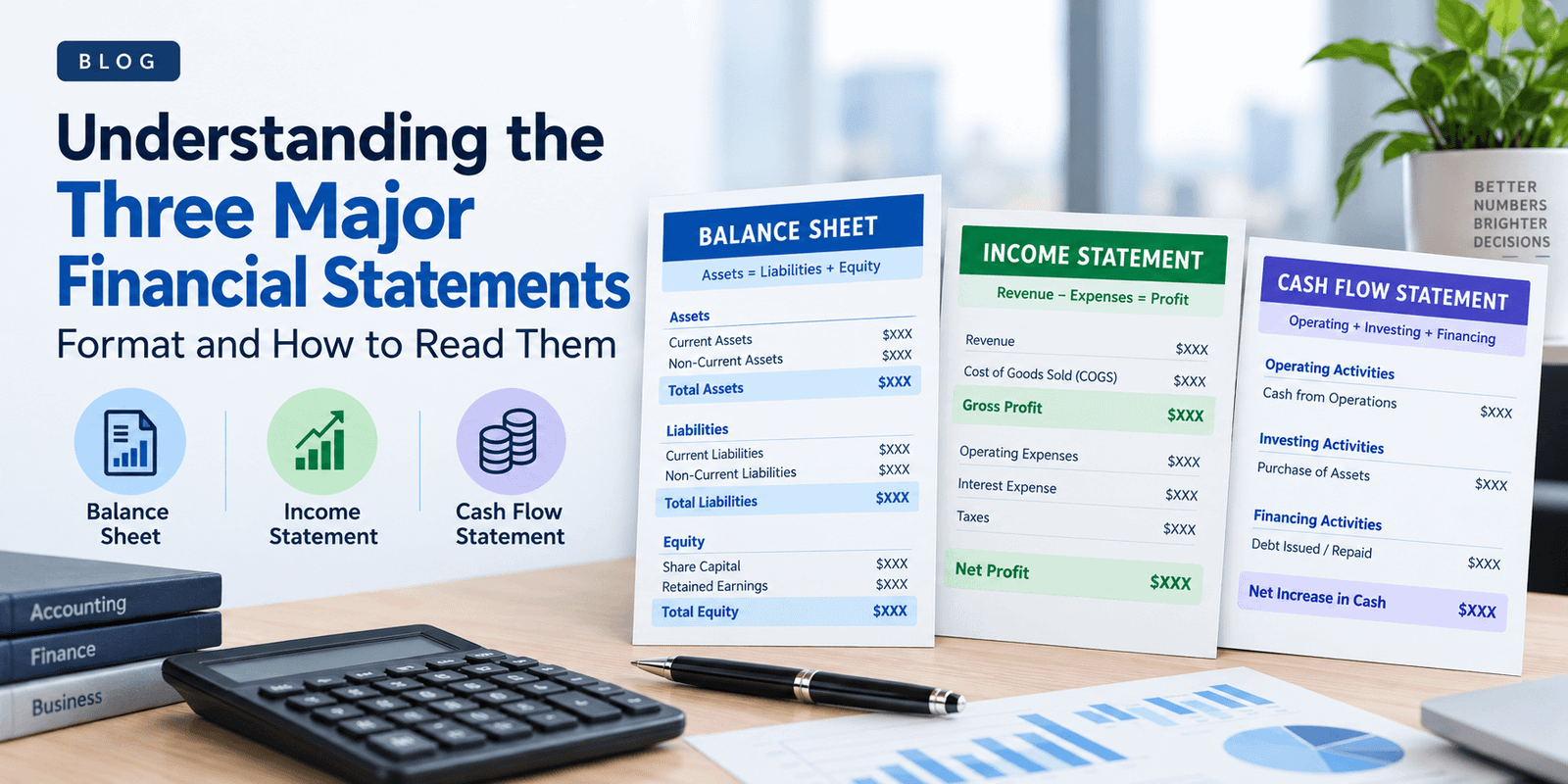
The three major financial statements are the Income Statement, Balance Sheet, and Cash Flow Statement. Each statement provides a different view of the business, but together they provide a complete picture of its financial position and performance.
Quick Overview: The Income Statement shows profitability, the Balance Sheet shows financial position, and the Cash Flow Statement shows how cash moves through the business.
1. Income Statement
The Income Statement, also known as the Profit and Loss Statement or P&L, shows a company's revenues, expenses, and profit or loss over a specific period.
It answers one important question: Is the business making money?
What Does an Income Statement Show?
- Revenue or Sales
- Cost of Goods Sold (COGS)
- Gross Profit
- Operating Expenses
- Operating Income
- Other Income and Expenses
- Net Income or Net Loss
Income Statement Format
| Income Statement | Amount |
|---|---|
| Revenue | $100,000 |
| Cost of Goods Sold | $40,000 |
| Gross Profit | $60,000 |
| Operating Expenses | $30,000 |
| Operating Income | $30,000 |
| Other Expenses | $5,000 |
| Net Income | $25,000 |
How to Read an Income Statement
When reading an Income Statement, start by looking at revenue. Revenue tells you how much the business earned from selling its products or services during the period.
Next, look at the Cost of Goods Sold. The difference between revenue and COGS gives you the gross profit.
After that, review operating expenses such as salaries, rent, utilities, marketing, insurance, and other operating costs.
Finally, look at net income. Net income represents the profit remaining after expenses and other applicable items have been accounted for.
2. Balance Sheet
The Balance Sheet provides a snapshot of a company's financial position at a specific point in time.
Unlike the Income Statement, which covers a period of time, the Balance Sheet represents the company's financial position on a particular date.
The Balance Sheet is based on the fundamental accounting equation:
Assets = Liabilities + Equity
What Does a Balance Sheet Show?
- Assets
- Liabilities
- Shareholders' or Owners' Equity
Balance Sheet Format
| Balance Sheet | Amount |
|---|---|
| Assets | |
| Cash | $20,000 |
| Accounts Receivable | $30,000 |
| Inventory | $25,000 |
| Property & Equipment | $75,000 |
| Total Assets | $150,000 |
| Liabilities & Equity | |
| Accounts Payable | $20,000 |
| Loans Payable | $50,000 |
| Owner's Equity | $80,000 |
| Total Liabilities & Equity | $150,000 |
How to Read a Balance Sheet
Start by reviewing the company's assets. Assets are resources controlled by the business that are expected to provide future economic benefits.
Current assets may include cash, accounts receivable, and inventory, while non-current assets may include property, equipment, and other long-term assets.
Next, review liabilities. Liabilities represent amounts the business owes to other parties.
Finally, review equity. Equity represents the owners' residual interest in the business after liabilities are deducted from assets.
3. Cash Flow Statement
The Cash Flow Statement shows how cash enters and leaves a business during a specific period.
A business can report a profit on its Income Statement and still experience cash-flow problems. This is why understanding cash flow is important.
The Three Sections of Cash Flow
- Operating Activities – Cash generated or used by the company's normal business operations.
- Investing Activities – Cash related to purchases or sales of long-term assets and investments.
- Financing Activities – Cash related to borrowing, repayment of debt, owner investments, dividends, or other financing transactions.
Cash Flow Statement Format
| Cash Flow Statement | Amount |
|---|---|
| Operating Activities | |
| Cash from Operations | $35,000 |
| Investing Activities | |
| Purchase of Equipment | -$15,000 |
| Financing Activities | |
| Loan Proceeds | $20,000 |
| Loan Repayment | -$5,000 |
| Net Change in Cash | $35,000 |
How to Read a Cash Flow Statement
Begin with operating cash flow because it shows how much cash the core business operations are generating or consuming.
Then review investing activities to understand whether the business is investing in assets or generating cash from investments.
Finally, review financing activities to understand how the business is funding its operations and investments through debt or equity.
How the Three Financial Statements Connect
The three financial statements are not separate documents. They are connected and together provide a complete view of the company's financial activity.
Net income from the Income Statement affects retained earnings or owner's equity on the Balance Sheet.
Changes in balance sheet accounts such as receivables, payables, inventory, debt, and cash help explain changes in cash flow.
The ending cash balance reported in the Cash Flow Statement connects to the cash balance reported on the Balance Sheet.
Example: Reading All Three Statements Together
Consider a business that reports strong revenue and a positive net income on its Income Statement.
Its Balance Sheet shows a significant amount of accounts receivable, meaning customers owe the business money.
At the same time, the Cash Flow Statement shows low operating cash flow.
Looking at all three statements together can provide additional context that may not be visible from the Income Statement alone.
Common Mistakes When Reading Financial Statements
1. Looking Only at Revenue
High revenue does not automatically mean a business is profitable or generating enough cash.
2. Ignoring Cash Flow
Profit and cash are not always the same. A business can report accounting profit while experiencing cash-flow pressure.
3. Ignoring Liabilities
A business may have significant assets but also carry substantial liabilities.
4. Looking at Only One Period
Reviewing financial statements over multiple periods can help identify trends in revenue, expenses, assets, liabilities, profitability, and cash flow.
5. Not Connecting the Statements
Each financial statement provides a different perspective. Reading them together provides a more complete understanding of the business.
A Simple Way to Remember the Three Statements
Income Statement: How profitable is the business?
Balance Sheet: What does the business own and owe?
Cash Flow Statement: Where is the cash coming from and where is it going?
Final Thought
Understanding financial statements is an important skill for business owners, accountants, investors, managers, and anyone involved in financial decision-making.
The Income Statement explains profitability, the Balance Sheet explains financial position, and the Cash Flow Statement explains movements in cash.
When these three statements are reviewed together, they provide a more complete picture of a company's financial performance, position, and cash situation.
Need Reliable Accounting & Bookkeeping Support?
UFMNET provides professional accounting, bookkeeping, financial statement preparation, data entry, tax support, and back-office services for CPA, tax preparation, and accounting firms.
Get in Touch