
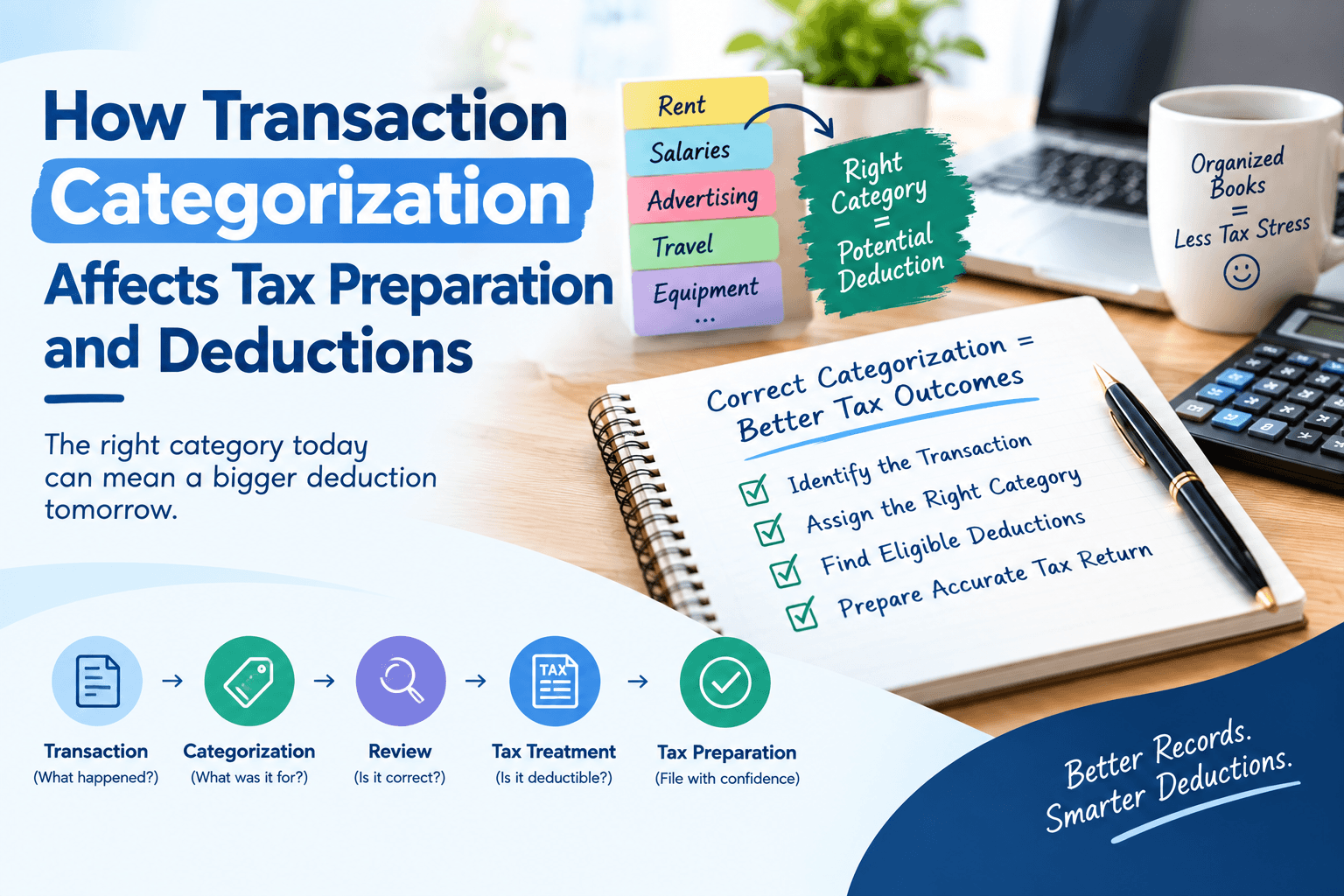
Transaction Categorization: Why It Matters for Your Business and Tax Preparation
Introduction
When we talk about bookkeeping, we often focus on recording transactions. But recording a transaction is only the beginning.
The next important question is:
This is where transaction categorization becomes important.
A transaction may be recorded in the books, but if it is categorized incorrectly, the financial statements may not accurately show the nature of the expense. This can also make it difficult for the tax preparer to identify expenses that may qualify for a tax deduction.
Every Business Has Hundreds of Transactions
Every business has hundreds or thousands of transactions during the year.
For example:
- $2,000 paid to employees
- $1,500 paid for office rent
- $800 spent on advertising
- $500 spent on office supplies
- $1,000 spent on business travel
- $5,000 paid for a computer or equipment
The first step is to record these transactions.
But recording the amount alone is not enough.
We need to ask:
What was the money spent for?
That answer helps determine how the transaction should be categorized.
2. What Is Transaction Categorization?
Categorization means assigning a transaction to the appropriate account or category based on its nature and business purpose.
For example:
| Transaction | Possible Category |
|---|---|
| Employee payment | Salaries/Wages |
| Office rent | Rent Expense |
| Google/Facebook advertising | Advertising Expense |
| Office stationery | Office Supplies |
| Business trip | Travel Expense |
| Computer purchased for business | Fixed Asset |
So, we can think about the process like this:
The transaction tells us what happened, while the category helps us understand what the transaction represents.
3. How Wrong Categorization Can Affect Tax Preparation
This is one of the most important reasons why categorization matters.
Suppose a business spends $10,000 on advertising during the year.
If the transactions are correctly categorized as Advertising Expense, the tax preparer can easily identify the amount and review it for appropriate tax treatment.
But what if those transactions are incorrectly categorized as:
Miscellaneous Expense
Owner's Expense
Another unrelated account
The expense may still exist in the accounting records, but the incorrect classification can make it harder for the tax preparer to identify and properly review it.
This can result in a potential deduction being missed, questioned, or requiring additional investigation.
4. Wrong Categorization Can Cause a Business to Miss Potential Deductions
Let's take a simple example.
Advertising: $10,000
Business travel: $5,000
Office supplies: $3,000
Professional fees: $7,000
Now imagine the bookkeeping records incorrectly classify most of these transactions under Miscellaneous Expense.
The total expenses may still appear in the books, but the tax preparer now has less visibility into what those expenses actually represent.
The tax preparer may need to go back through individual transactions, invoices, receipts, and other supporting documents to determine their nature and appropriate tax treatment.
5. Recording an Expense Does Not Automatically Make It Deductible
This is another important point.
Just because something is recorded as an expense in the accounting system does not mean it automatically qualifies as a tax deduction.
For example, a business owner may spend $2,000 using the business bank account.
The transaction is recorded.
But we still need to ask:
- What was the payment for?
- Was it related to the business?
- Which account should it belong to?
- Is there supporting documentation?
- What is the applicable tax treatment?
- Does it meet the requirements for a deduction?
So the process is:
Categorization helps organize the information, but tax law determines whether and how an expense can be deducted.
6. Why Categorization Makes Tax Preparation Easier
Good categorization gives the tax preparer a much clearer picture of the business's financial activity.
For example, instead of seeing:
The tax preparer may see:
Advertising — $10,000
Travel — $5,000
Office Supplies — $3,000
Professional Fees — $7,000
Software — $8,000
Other Expenses — $12,000
Now the tax preparer can review each category and determine the appropriate tax treatment more efficiently.
This reduces the need to investigate every individual transaction from the beginning.
7. Categorization Can Also Identify Accounting Errors
Categorization is not only about tax deductions.
It can also help identify mistakes in the books.
For example, suppose a business purchases a $5,000 computer.
If the transaction is recorded as Office Supplies Expense, the books may not properly reflect the nature of the purchase.
Depending on the applicable accounting and tax rules, the item may need to be treated differently, such as a fixed asset, rather than simply treating the entire purchase as an ordinary expense.
8. The Role of the Bookkeeper and Tax Preparer
Bookkeeping and tax preparation are connected, but they are not the same process.
Bookkeeper
The bookkeeper focuses on:
- Recording transactions
- Categorizing transactions
- Reconciling accounts
- Maintaining supporting information
- Preparing accurate financial records
Tax Preparer
The tax preparer uses those records to:
- Review income and expenses
- Identify relevant tax information
- Apply applicable tax rules
- Determine appropriate tax treatment
- Prepare the tax return
Good bookkeeping gives the tax preparer better-quality information to work with.
The Complete Thought Process
This is the complete process to keep in mind when recording and categorizing business transactions:
Final Thought
A transaction is the starting point. Categorization gives the transaction meaning. Accurate categorization makes the financial records easier to understand and helps the tax preparer identify and review potential deductions.
At the same time, categorization alone does not determine whether an expense is deductible. The final tax treatment depends on the applicable tax rules, business purpose, documentation, and other requirements.
Need Help With Your Bookkeeping?
UFMnet provides professional accounting, bookkeeping, payroll, tax preparation, and financial consulting services for businesses across the USA.
Let us handle the numbers while you focus on your business.
Get in Touch